
May 21, 20247 min readUpdated May 6, 2026
Top Use Cases and Applications of AI Chatbots for Business
Artificial intelligence (AI) chatbots have exploded in popularity in recent years. By 2025, Gartner predicts that customers will prefer chatting with bots over humans for customer service. As conversational AI continues
Artificial intelligence (AI) chatbots have exploded in popularity in recent years. By 2025, Gartner predicts that customers will prefer chatting with bots over humans for customer service. As conversational AI continues advancing, chatbots are expanding beyond basic website pop-ups into diverse, impactful applications across industries.
In this comprehensive guide, we’ll examine the top ways businesses are leveraging AI chatbots to serve customers, generate leads, and drive results.

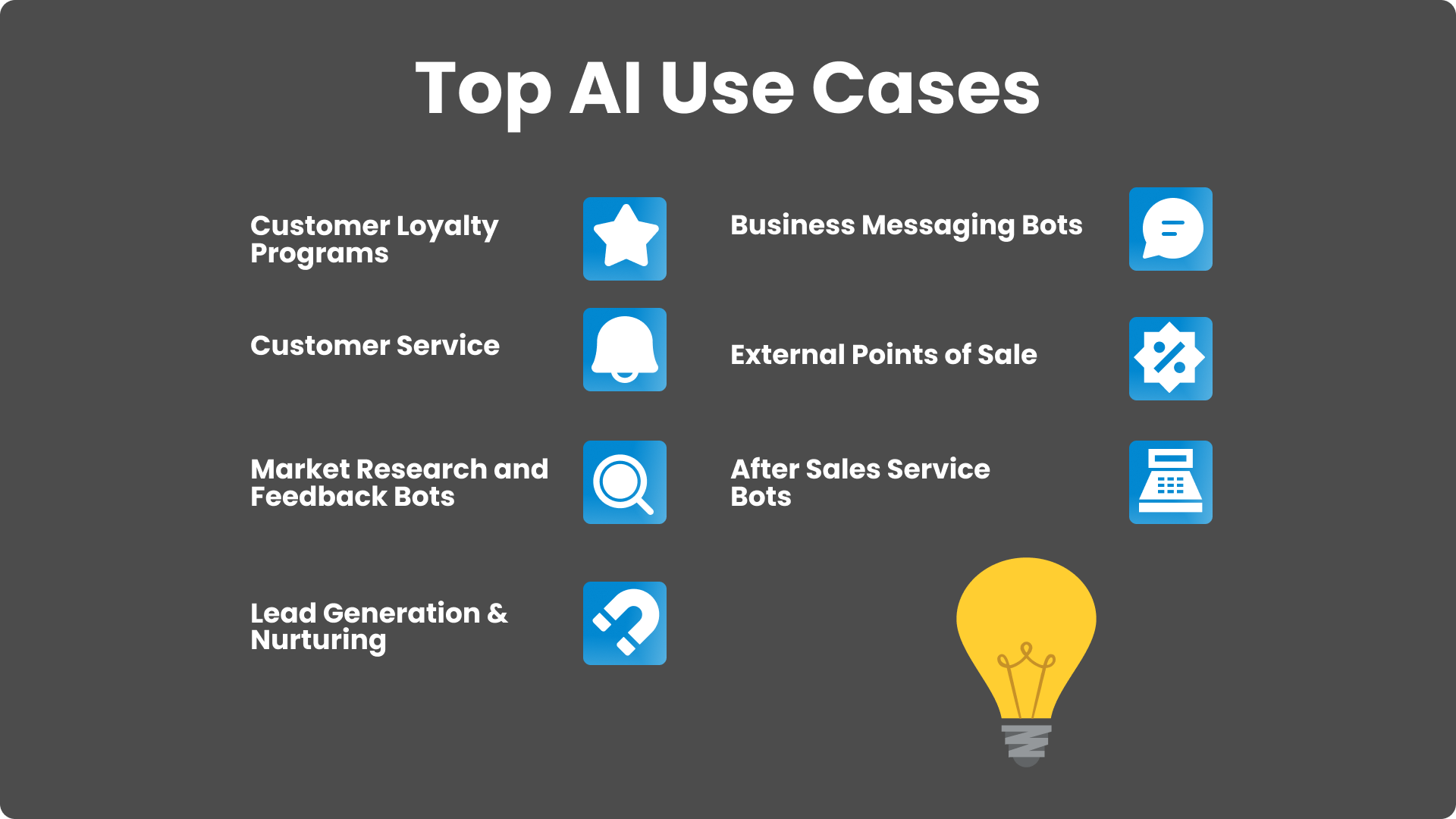
Top Ai Use Cases by Just Think AI
AI Chatbots for Customer Service
Providing instant, 24/7 customer support is one of the most common and valuable uses of chatbots. AI-powered conversational agents can field a wide range of common service and support questions from customers without requiring human staffing around the clock.
According to SBI research, 57% of customers prefer chatbots over humans for simple inquiries. Chatbots provide fast, convenient resolutions without wait times or transfers. Key customer service applications include:
Answering Common Questions
Chatbots reliably handle frequent questions customers ask regarding shipping, returns, account access, order status, cancellations, product details, and more. Natural language processing identifies intents, while a knowledge base provides answers immediately.
Addressing Billing and Payment Issues
Queries related to account balances, charges, payment options, invoices, and transaction disputes can be fielded efficiently by AI chat agents. They access customer account information to resolve billing problems.
Booking Appointments
Chatbots allow customers to book appointments or reservations directly through conversational interaction. Users can check availability, select times, provide contact info, and confirm bookings rapidly.
Managing Feedback and Complaints
Angry or frustrated customers can be defused by chatbots trained in sentiment analysis and de-escalation. Agents gauge emotions, apologize, and guide customers to resolution while transferring complex complaints to human reps.
Providing Account Assistance
Password resets, login troubleshooting, access requests, and other common account management issues can be handled fully by AI chatbots, eliminating wait times. Integrations pull customer data in real-time.
Recommending Helpful Resources
When questions fall outside a bot's knowledge base, it can suggest relevant self-service content like help center articles, FAQs, and community discussions to solve the user's problem or query.
Lead Generation with Chatbots
Many companies are leveraging AI chatbots for lead generation by proactively engaging site visitors in conversational lead qualifying. Chatbots can:
Qualify Leads with Questions
Chatbots interact with prospects through branched questionnaires tailored to business needs. Based on conversational responses, they determine if visitors match target buyer profiles.
Provide Relevant Offers
Product recommendations and special deals are presented conversationally to prospects that exhibit purchase intent signals during chats. Personalized offers boost conversion rates.
Book Sales Consultations
When site visitors show interest, chatbots can automatically schedule meetings with sales reps. Calendly integration streamlines booking without leaving the conversation.
Capture and Route Leads
Qualified leads are instantly captured by chatbots via forms or by requesting contact info. Promising prospects are routed to CRM and sales workflows for timely follow-up.
Remarket Across Channels
Users who don’t convert initially can be re-engaged via email, ads, and chatbot messages on other platforms like Facebook Messenger using behavioral targeting.
Generate Referrals
Happy customers can organically refer friends and colleagues through conversational CTAs. Chatbots make sharing and sign-ups frictionless to drive viral growth.
Conversational lead gen creates highly personalized, interactive experiences that convert anonymous visitors into real business opportunities.
Chatbots for Appointment Booking
Scheduling appointments over the phone or email can be tedious and time consuming. AI chatbots streamline and automate booking workflows through natural conversational interfaces.
Check Availability
Users simply inform the bot of the service needed and desired date/time. The chatbot checks availability and presents options.
Select Appointment Times
Customers review openings presented by the chatbot and confirm the best date and time for them. Bots answer questions to aid selection.
Provide Contact Information
Chatbots request necessary contact details like name, email and phone number to complete bookings and send confirmations.
Confirm Reservations
Final booking details are summarized and confirmed prior to creation. Customers can request changes or approve the appointment.
Manage Cancellations/Rescheduling
Existing appointments can easily be rescheduled or cancelled through chatbot interactions. Alterations are handled nimbly.
Conversational booking eliminates frustrating IVR phone trees or back-and-forth emails. Customers value the instant, personalized booking facilitated by AI chat agents.
FAQ Chatbots
Customers appreciate getting quick answers to their frequently asked questions. FAQ chatbots solve common inquiries instantly using an extensive knowledge base.
Respond to Prevalent Questions
A properly designed FAQ database empowers chatbots to address a wide breadth of common customer questions and pain points around the clock.
Continuously Expand Knowledge
As new questions emerge, they are logged and used to expand the knowledge base. Machine learning constantly grows the bot’s capabilities.
Offer Suggested Articles
For queries outside the FAQ content, chatbots will recommend relevant help articles, community threads, and support resources to solve the customer’s issue.
Transfer to Humans When Needed
When questions fall outside its scope, the chatbot seamlessly transfers customers to human agents for resolution while providing context.
Guide Users Intuitively
Natural conversation design, including clarifying questions, provides an intuitive user experience that funnels questioners to answers quickly.
Well-programmed FAQ chatbots satisfy customers’ need for self-service while reducing strain on live support teams. Their knowledge scales infinitely to handle surges.
Order Status Chatbots
Order status is one of the most frequent reasons customers contact support. AI chatbots enable instantly checking order progress without waiting on hold or digging through account history.
Look Up Order Details
Chatbots first authenticate users, then allow them to simply share the order number or identifier to pull up status.
Check Multiple Points
Bots can provide updates on the full order lifecycle, from processing to shipment to delivery, using real-time order data from backends.
Answer Related Questions
Conversations handle common questions around estimated arrival, tracking information, return policies, cancellations, and more based on order status.
Facilitate Changes
Chatbots can alter orders by triggering cancellations, returns, or changes when authorized by customers through chat.
Drive Post-Purchase Engagement
Users receive proactive order updates, reminders, and other continuing engagement through the buying journey via ongoing bot conversations.
Order status bots boost convenience, satisfaction, and retention with on-demand access to purchase progress.
Personalized Chatbot Recommendations
Leveraging AI, chatbots build rich customer profiles to deliver hyper-personalized product recommendations, deals, and content during conversations.
Tailor Suggestions
To Individuals
Purchase history, browsing behavior, and other CRM data informs relevant product suggestions tailored to what each customer truly wants.
Provide Timely, Targeted Offers
Chatbots deliver limited-time promotions and specials timed precisely when a user is most likely to engage, based on individual habits and preferences.
Curate Personalized Content
Conversationally presenting articles, tips, and other content matched to someone’s interests helps keep them engaged and informed.
Build Loyalty Through Relevance
Thoughtful, personalized recommendations make customers feel valued. The tailored experience fosters trust and brand loyalty.
Boost Conversions with Smart Triggers
Users receive special incentives to complete desired actions like purchases, reviews, or referrals through behavioral targeting.
Smarter personalization drives sales, retention, and satisfaction by delivering the right message to each customer at the right time.
The Future of Conversational AI
While AI chatbots already provide immense value across these key use cases, the technology is still just scratching the surface of its potential. Some emerging developments to expect:
- More human-like conversations as linguistic models leverage generative AI to craft responses on the fly instead of just matching pre-scripted content.
- Tighter integration between chatbots and backend systems like CRM software, marketing automation, calendars, and internal knowledge bases via APIs. This will allow bots to pull and act on data in real-time during conversations.
- Widespread adoption across industries as capabilities improve and customers come to expect conversational interfaces for everything from banking to healthcare.
- Growth of voice assistants like Siri, Alexa and Google Assistant as homes and cars get smarter. Voice expands the use cases for virtual assistants.
- Visual bots with emojis, avatars, and screen interactions for more expressive and engaging conversations.
- Proactive bot outreach powered by intelligence like predictive lead scoring and next-best-action modeling. Bots will initiate personalized interactions when timing is optimal.
The conversational AI landscape is advancing rapidly. Following best practices around use cases, design and integration outlined here will help future-proof chatbot initiatives.
Conversational AI for Business Success
This guide provided an in-depth look at how leading companies deploy AI chatbots today to serve customers, generate leads, and drive results.
Key takeaways include:
- Focus on high-impact use cases like customer service, lead gen, bookings and FAQs.
- Design natural, intuitive dialogue with human-centric conversations.
- Integrate with backend systems for data-driven personalization.
- Monitor performance and continuously expand bot capabilities over time.
- Deploy an omnichannel bot presence to engage audiences everywhere.
With best practices, cutting-edge AI, and a strategic roadmap, conversational interfaces will transform how your business connects with customers in the years ahead. The opportunity to delight your audience and grow with chatbots starts now.